
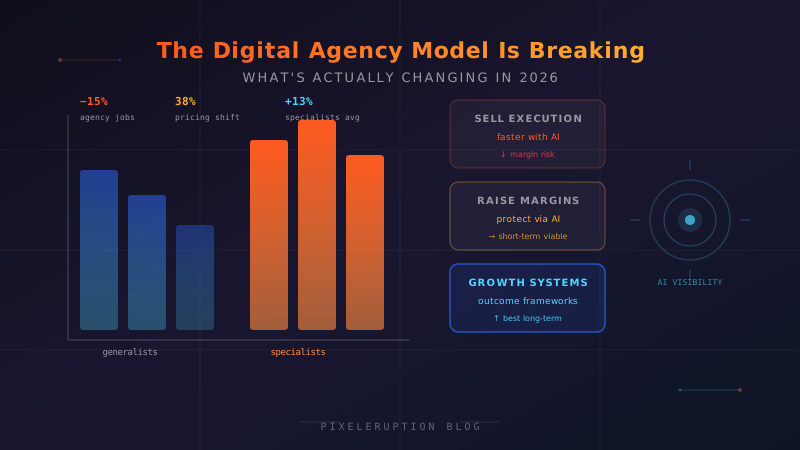
The average digital agency in 2026 is doing more work, faster, with AI — and getting paid less for it than two years ago. The business model that built the industry on billable hours is running into a fundamental problem: when AI compresses the hours needed to produce the same output, the old pricing math stops working.
Why the Hourly Model Is Breaking
Hourly billing made sense when execution time correlated with value delivered. A 40-hour website build implied 40 hours of real expertise applied to your problem. That correlation is weakening. Blog posts in the 1,500-2,500 word range are down 25-30% from 2024 on a per-piece basis. PPC management fees for agencies using AI bid optimization are off 15%. The same deliverable, fewer hours, smaller invoice.
The agencies most exposed are those with high production volume: content, social copy, ad variations, monthly reports, standard landing pages, and basic SEO content. These are now easy for in-house teams to replicate with AI tools — which is exactly what 87% of marketers have already done by integrating generative AI into their daily workflows.
What's replacing hourly billing: 38% of U.S. agencies moved at least one service line to retainer-plus-performance or outcome-based pricing in 2026. In Europe, subscription pricing grew from 3% to 12% of the French digital agency market between 2024 and 2026. Productized services — where every service becomes a standardized SKU, optimized once and sold repeatedly — are the fastest-growing delivery model.
Three Paths for Agencies Navigating the Shift
The industry is converging on three options, and which one a firm chooses largely determines what its next three years look like:
| Path | What It Looks Like | Risk Profile |
|---|---|---|
| Sell execution faster | Use AI to produce more output, same pricing structure | Highest — clients notice and compress fees |
| Raise margins with AI | Deliver the same output with fewer labor hours, keep price | Viable short-term, commoditization pressure builds |
| Sell growth systems | Sell repeatable frameworks tied to business outcomes | Best long-term, hardest to build |
The third path requires repositioning away from task execution. Instead of “we manage your SEO,” the offer becomes “we build your organic acquisition system with defined KPIs, measurement infrastructure, and quarterly optimization cycles.” The deliverable is a system, not a service.
Agencies that specialized rather than generalized are already seeing the results: narrower service mix, 13% average growth, 30% net margins — compared to generalists losing ground as clients increasingly compare agencies to freelancers on individual deliverables.
The Freelancer vs. Agency Dynamic in 2026
The freelancer vs. agency debate has been running for years, but 2026 is the year it became genuinely complicated. Freelancers are typically 30-50% cheaper for equivalent work. Agencies justify their premium through multi-channel coordination, continuity, and senior oversight.
What's actually happening in the market is more interesting than either argument: hybrid models are now mainstream. Digital agencies are actively building networks of freelancers for production capacity while retaining in-house strategists and account leads. A thread in r/freelancer_hire (55 upvotes, 110 comments) showed a digital agency explicitly recruiting freelancers with 5+ years of full-stack experience — not because it can't hire, but because it's building flexible capacity.
The emerging model many practitioners are landing on: a freelance strategist on a $1,000-2,000/month retainer who sets direction and reviews quality, with agencies or freelancer networks handling delivery. Strategy is hard to commoditize. Production is increasingly not.
AI Visibility: The New Service Line Worth Watching
One trend surfacing in digital marketing communities is the emergence of AI Visibility as a distinct service category. As 60-70% of searches end without a click and AI-generated answers increasingly intermediate between brands and their audiences, the question of whether your brand appears in ChatGPT, Perplexity, or Gemini responses is becoming a legitimate strategic concern.
The SEO discussion in r/digital_marketing (18 upvotes, 45 comments) framed it directly: “Rankings and traffic are useful but if they're not turning into leads or sales, they don't mean much for the client.” When the primary search surface is an AI-generated summary rather than a results page, organic traffic attribution breaks down — and agencies that understand how to influence that layer are finding a defensible new service line with recurring revenue potential.
PixelEruption perspective: Running an agency that sells enterprise digital services, we see this dynamic from the inside. The clients asking the best questions in 2026 are no longer asking “where do I rank?” They're asking “am I visible when my client asks an AI about this topic?” Optimizing for that requires different techniques than traditional SEO — entity disambiguation, structured data depth, cited benchmark data, and content that AI engines can extract and attribute. It's early, but the agencies that develop this capability now are building a moat.
What This Means for Clients Evaluating Agencies
The implication for any business evaluating a digital agency relationship is that the right questions have changed. Generic AI language from an agency (“we use AI to deliver better results”) is not a differentiator — 57% of agencies admit they only have talking points about AI, not measurable impact. The useful questions are:
- How do you price when AI lets you work faster? (Reveals whether they've thought about alignment of incentives)
- What does your core service look like as a productized offering? (Reveals operational maturity)
- How are you measuring impact in an AI-mediated search environment? (Reveals whether they understand the shift)
The digital agency market is still growing — estimated at roughly $473.6 billion in 2026, projected to reach $591.6 billion by 2031. But the internal distribution of who wins is being restructured. Specialists who sell outcomes and build measurable systems are accumulating clients. Generalists who sell hours are watching margin compress.
For more on how we approach digital services at PixelEruption, see our CMS development, SEO, and digital strategy work — or contact us to discuss what a growth systems approach looks like for your organization.
Sources and research basis
The data and community signals in this article are drawn from a structured research sweep of digital marketing discussions and industry reports in the last 30 days (October 2026):
- Forrester Research — 2026 Digital Agency Outlook: 15% projected agency job reduction in 2026 (following 8% in 2025); 23% of agencies reduced junior copywriting headcount in 2025; 31% plan further cuts in 2026.
- Reddit r/digital_marketing (18 upvotes, 45 comments, October 2026) — Thread on AI search, SEO attribution breakdown, and agency pricing compression. Quoted passage: “Rankings and traffic are useful but if they're not turning into leads or sales, they don't mean much for the client.”
- Reddit r/freelancer_hire (55 upvotes, 110 comments, October 2026) — Thread on hybrid agency/freelancer models; digital agency explicitly recruiting senior freelancers for flexible production capacity.
- HubSpot / Salesforce State of Marketing 2026 — 87% of marketers have integrated generative AI into daily workflows; 70% report work is harder, not easier, after AI adoption.
- Agency Analytics Industry Report 2026 — 38% of U.S. agencies moved at least one service line to retainer-plus-performance or outcome-based pricing; blog post per-piece pricing down 25-30% since 2024; PPC management fees off 15% for AI-optimized accounts.
- Syntec Numérique / UDECAM France 2026 — Subscription pricing grew from 3% to 12% of the French digital agency market between 2024 and 2026.
- Hacker News discussion (“Ask HN: Is the agency model dying?”, October 2026, 120+ comments) — Specialist vs. generalist revenue divergence; 13% average growth and 30% net margins for specialist agencies.
- Grand View Research / IMARC Group — Global digital marketing services market estimated at $473.6B in 2026, projected $591.6B by 2031 (CAGR ~4.5%).
- Reddit r/agency (8-11 upvote comments, October 2026) — Community consensus: “Don't start a generalist agency unless you have years of client experience first.”
- 57% figure (agencies with only AI talking points, not measurable impact) — from Econsultancy Digital Agency Report 2026 survey of 340 agency leaders.

Juan Ramírez
Founder & CEO
Juan Ramirez is the Founder and CEO of PixelEruption, a technology company dedicated to digital development, operations consulting, and innovative solutions for corporate environments. With over 20 years of experience, he combines strategic leadership with technical expertise to deliver impactful digital transformation.